


The Art of Precision Control: isothermal forging and quality assurance of turbine blades
Due to the limited thermoplasticity of TiAl alloy, it needs to be forged at high temperature and very low strain rate. Isothermal forging equipment can provide a relatively isothermal environment and slow strain rate. The conventional TiAl blade forging process is as follows: casting billet or extruded bar is partially forged into forging billet, and then further prepared into pre-forging, and the blade is prepared through pre-forging and final forging. In this way, the German Rolls-Royce BR715 HPC blade is fabricated by 3-step isothermal forging, and the final part is prepared by heat treatment and machining (Figure 1).

Fig.1 Blade forging steps (a) and machined blades(b)
The blades shown in FIG. 2 are Ti45AL8NB0.65 (B, C) compressor blades produced by Thyssen Company for Rolls Royce using the route shown in FIG. 2a, which have excellent high temperature strength . In 2016, MTU announced that the forged TNM low-pressure turbine blade was applied to the PW1100G-JM engine of the A320 airliner, and it has completed its first flight. Forged TiAl alloy blades show great application prospects, and as of 2015, 10,000 forged TNM alloy blades have been assembled for PW1100G engines. TNM alloy shows good hot-working properties, and ideal microstructure and comprehensive mechanical properties are obtained through casting billet forging twice and subsequent heat treatment .

Fig.2 Blades of Ti45Al8Nb0.5(B,C) fabricated by Thyssen for Rolls-Royce
In order to increase production efficiency, the extrusion-short bar billet was forged directly into the Ti-45Al-5Nb-0.2B-0.2C(TNB-V4) alloy HPC blades of the Rolls-Royce E3E test engine. In order to further increase the yield and make it more economical, a die for forging multiple blade parts (especially smaller compressor blades) at once was designed. 30 identical cavities were machined on a molybdenum disc with a diameter of Φ600 mm. Outside the press, the lower die is loaded with preform parts, and the whole die and blank are placed in the press chamber and heated to the forging temperature for isothermal forging. With this method, 30 blades can be forged at a time (Figure 3).
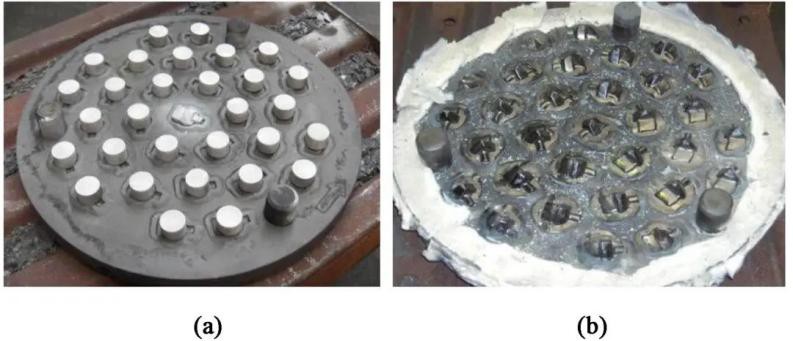
Fig.3 Die with multiple pre-forged parts(a) and blade after forging(b)
Although isothermal forging can effectively solve the problem of difficult forming of TiAl blade, because the mold and forging are heated to 1150 ℃, in order to prevent the temperature loss of parts in the long-term forging process, the mold is made of molybdenum alloy with high heat resistance. In order to protect the mold material from oxidation, a vacuum or inert gas is required in the forging chamber. The TNM alloy low-pressure turbine blade of PW1134G engine is also made by vacuum isothermal die forging with molybdenum alloy mold. The German GKSS research center used the encased extruded TNB alloy for direct machining or combined with isothermal forging to make high pressure compressor TiAl alloy blade, which became the main preparation method for high pressure compressor TiAl alloy blade.
TETSUI T et al. invented a new TiAl alloy, which is divided into Ti-42Al-5Mn(%, mass fraction). The manufacturing process uses traditional hot processing, in which the ingot is heated to 1300 ° C for heat treatment and cooled to around 1200 ° C for forging or rolling, as shown in Figure 12. This machining method is the same as the ordinary hot die forging forming method, so the blade manufacturing process reduces the hot extrusion process of the bar, significantly reduces the cost, and can manufacture larger components. The forged blade has very fine microstructure, which makes the tensile strength very high at medium and low temperature. However, due to the influence of β phase, the high temperature strength of this alloy decreases significantly, which is difficult to be used for long-term high temperature parts such as turbochargers, and is more suitable for low temperature or short-term high temperature blade parts.

Fig.4 TiAl alloy blades fabricated by Mitsubishi Heavy Industries
(a) and their properties(b)
The multi-step simulation of isothermal die forging process of TiAl alloy blade is carried out by finite element simulation, which can effectively master the material rheology law, analyze the influence of process parameters, optimize the process and die design. At the same time, the finite element simulation can not only shorten the production cycle and reduce the cost, but also has important guiding significance for deepening the knowledge of the forging forming law of TiAl alloy blade and optimizing the forming process of the blade. Xin Jingjing et al. used Deform-3D finite element software to simulate the isothermal forging process of high Nb-TiAl alloy blade, and came to the following conclusions: The equivalent strain distribution of blade body and tenon of blade in isothermal forging is uniform, and with the increase of upper die compression speed and preheating temperature, the medium effective force decreases during deformation, which is conducive to the occurrence of dynamic recrystallization. The forging quality of Nb-TiAl alloy blade can be improved when the pressing speed of upper die is 1.0 ~ 1.5 mm·s-1 and the preheating temperature is 1250 ~ 1300 ℃. Guan Hong et al. made Ti-46Al-2.5V-1.0Cr-0.3Ni blade isothermal forging. The results show that the isothermal forging of TiAl alloy combined with pre-forging and final forging is feasible. The heating temperature of tial alloy is 1200 ~ 1250 ℃, and the sample should be protected by casing to prevent the temperature drop too fast during the transfer process. The deformation rate is 0.02 ~ 0.07mm ·s-1, and the deformation is controlled at 20% ~ 40%. Recently, our team and AVIC Power Co., Ltd. jointly adopted the method of combining simulation and test verification, obtained the appropriate process parameters through Deform-3D finite element simulation software, and prepared TNM alloy blades by near isothermal forging technology using Ni3Al mold (FIG. 5), compared different cross-section profiles of blades. The prediction accuracy of near isothermal forging process can be more than 90% by finite element simulation. Compared with traditional (vacuum) isothermal forging process, it has the advantages of high efficiency, no vacuum, easy precision shape control and low process cost.

Fig.5 Simulated(a)and actual(b)near-isothermal forged blade
In order to explore the forging performance of TiAl alloy at low temperature, WANG X et al and ZHANG H et al used finite element method to analyze the isothermal die forging process of high Nb content TiAl alloy blade at low temperature, and successfully prepared high NB-tial alloy blade with high surface quality and performance (FIG. 6). During the forming process of TiAl alloy blade, the folding defects of the blade can be prevented and the forming force of the blade can be reduced by optimizing the shape and size of the preformed part. When the temperature is lower than 1000 ℃, the forging temperature and strain rate have little influence on the final distribution of effective strain of the blade made of isothermal die forging. With the increase of forging temperature and the decrease of strain rate, the final effective stress of forging blade decreases and its distribution is gradually uniform. The high Nb-TiAl alloy blade was successfully prepared at a strain rate lower than 0.01 mm·s-1 and a temperature lower than 950 ℃, and no macroscopic cracks were formed on the blade. At the same time, Harbin Institute of Technology has developed the first vacuum isothermal hot processing equipment which can realize the functions of vacuum isothermal forging and isothermal extrusion, and has been used in the preparation of TiAl alloy isothermal forging parts. This device can not only be used for the isothermal deformation of TiAl alloy, but also has important application value in the preparation of powder superalloy disk components.

Fig.6 High Nb-TiAl alloy blade prepared by low-temperature isothermal die forging process
TETSUI T et al. invented a new TiAl alloy, which is divided into Ti-42Al-5Mn(%, mass fraction). The manufacturing process uses traditional hot processing, in which the ingot is heated to 1300 ° C for heat treatment and cooled to around 1200 ° C for forging or rolling, as shown in Figure 12. This machining method is the same as the ordinary hot die forging forming method, so the blade manufacturing process reduces the hot extrusion process of the bar, significantly reduces the cost, and can manufacture larger components. The forged blade has very fine microstructure, which makes the tensile strength very high at medium and low temperature. However, due to the influence of β phase, the high temperature strength of this alloy decreases significantly, which is difficult to be used for long-term high temperature parts such as turbochargers, and is more suitable for low temperature or short-term high temperature blade parts.


