




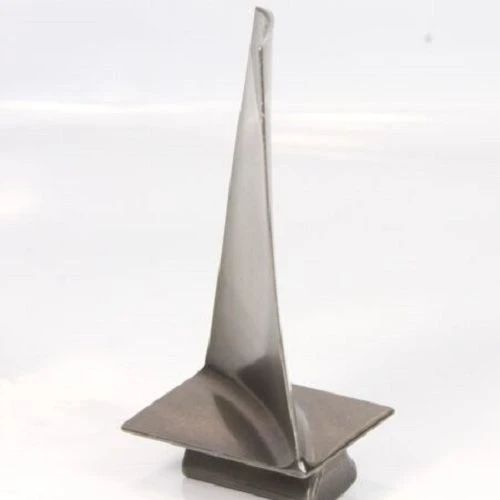


CNC Machining Turbine Blade
OEM & ODM Services: Available
Weight: Custom
Tolerance:0.004mm
Smooth surface roughness:Ra0.6-3.2
CNC machining of turbine blades involves using Computer Numerical Control (CNC) technology to manufacture turbine blades with high precision and accuracy. CNC machining offers a controlled and automated process that can produce complex and intricate blade geometries required for various applications, including aircraft engines, power generation, and industrial machinery. Here's an overview of CNC machining for turbine blades:
CNC Machining Process for Turbine Blades:
Design and Modeling: The process begins with designing the turbine blade geometry using computer-aided design (CAD) software. The blade's dimensions, angles, airfoil shape, and cooling channels are defined in the digital model.
CAM Programming: Computer-aided manufacturing (CAM) software is used to generate tool paths based on the CAD model. The CAM software calculates the tool paths, cutting speeds, feeds, and other machining parameters.
Material Selection: The turbine blade material is chosen based on factors such as temperature, corrosion resistance, and mechanical properties. Common materials include nickel-based superalloys, titanium alloys, and other high-temperature alloys.
Setup: The workpiece (turbine blade) is securely mounted on the CNC machine's worktable using fixtures or clamps.
Tool Selection: Cutting tools with specific geometries, coatings, and cutting edges are selected based on the material and design requirements of the turbine blade.
CNC Machining: The CNC machine follows the programmed tool paths to remove material from the workpiece. The machine moves the cutting tool along multiple axes (typically 3 or 5 axes) to create the desired blade shape.
Finishing Operations: After rough machining, finishing operations are performed to achieve the required surface finish, tolerances, and dimensions. This may involve additional passes with different tools or processes.
Inspection and Quality Control: The machined turbine blades undergo thorough inspection using various measuring instruments, such as coordinate measuring machines (CMM) and optical measurement systems. This ensures that the blades meet the specified tolerances and quality standards.
Heat Treatment and Coating: Depending on the material and application, the turbine blades may undergo heat treatment to enhance their mechanical properties. Additionally, specialized coatings may be applied to improve wear resistance, corrosion resistance, and thermal performance.
Benefits of CNC Machining for Turbine Blades:
Precision and Consistency: CNC machining offers high precision and consistency, resulting in blades with accurate dimensions and tight tolerances.
Complex Geometries: CNC machines can create intricate airfoil shapes, cooling channels, and other complex features required for efficient turbine performance.
Efficiency: CNC machining allows for efficient material removal, reducing production time and optimizing tool paths for minimal waste.
Customization: CNC machining offers flexibility to produce turbine blades tailored to specific applications and design requirements.
Quality Control: CNC machines can be programmed for quality control checks during the machining process, ensuring deviations are identified and corrected promptly.
CNC machining is a vital process in the manufacturing of turbine blades, ensuring their performance, reliability, and safety in various industries where high-performance rotating machinery is essential.
Hot Tags: cnc machining turbine blade, China cnc machining turbine blade manufacturers, suppliers, factory, Superalloy Nickel Turbine Blade, Lost Wax Investment Casting Turbine Blade, Investment Casting Turbine Blade, Steam Turbine Blade, Nickel Alloy Turbine Blade, Jet Engine Turbine Blade
Previous
5 Axis Turbine BladeYou Might Also Like



Send Inquiry