


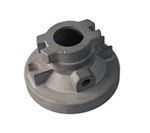


Vacuum Casting Turbine Wheel Blade
OEM & ODM Services: Available
Weight: Custom
Tolerance:0.004mm
Smooth surface roughness:Ra0.6-3.2

Material Selection:
Jet turbine blades are typically made from advanced materials known as superalloys. Superalloys exhibit exceptional heat resistance, mechanical strength, and resistance to corrosion, making them well-suited for the high-temperature environment of gas turbine engines.

Aerodynamic Design:
The profile of turbine blades is carefully designed to optimize their aerodynamic efficiency. This design maximizes the energy extraction from the exhaust gases while minimizing losses.

Cooling Mechanisms:
Due to the extreme temperatures they encounter, turbine blades often feature internal cooling channels or use specialized cooling techniques to prevent overheating and ensure structural integrity.

Precision Manufacturing:
Jet turbine blades are manufactured using advanced techniques such as investment casting or additive manufacturing (3D printing). These methods ensure the intricate geometries and precise tolerances necessary for efficient operation.
vacuum casting turbine wheel blade are a critical element of gas turbine engines, contributing to their efficiency, power output, and overall reliability. The continuous development of advanced materials, manufacturing methods, and aerodynamic designs enhances the performance and longevity of these essential components.
|
China |
U.S. |
||
|
TAD |
Titanium Iodide |
Grade1 |
No. 1 Pure Titanium |
|
TA1 |
Industrial Pure Titanium |
Grade2 |
No.2 Pure Titanium |
|
TA2 |
Industrial Pure Titanium |
Grade3 |
No. 3 Pure Titanium |
|
TA3 |
Industrial Pure Titanium |
Grade4 |
No. 4 Pure Titanium |
|
TA4 |
Ti-3Al |
Grade5 |
Ti-6AI-4V |
|
TA5 |
Ti-4A1-0.005B |
Grade6 |
Ti-5AI-2.5V |
|
TA6 |
Ti-5AI |
Grade7 |
Ti-0.2Pd |
|
TA7 |
Ti-5AI-2.5Sn |
Grade9 |
Ti-3A1-2.5V |
|
TA8 |
Ti-5A1-2.5Sn-3Cu-1.5Zr |
Grade10 |
Ti-11.5Mo-4.5Sn- 6Zr |
|
TC1 |
Ti-2AI-1.5Mn |
Grade1 |
Ti-0.2Pd |
|
TC2 |
Ti-3A1-1.5Mn |
Grade2 |
Ti-0.3Mo-0.75Ni |
|
TC3 |
Ti-4A1-4V |
A-1 |
Ti-5A1-2.5Sn |
|
TC4 |
Ti-6A1-4V |
A-3 |
Ti-6A1-2Nb-1Ta |
|
TC6 |
Ti-6Al-1.5Cr-2.5Mo-0.5Fe- 0.3Si |
A-4 |
Ti-8A-1Mo-1V |
|
TC7 |
Ti-6A1-0.6Cr-0.4Fe-0.4Si- 0.01B |
AB-1 |
Ti-6A1-4V |
|
TC9 |
Ti-6.5A1-3.5Mo-2.5Sn-0.3Si |
AB-3 |
Ti6AI-6V-2Sn |
|
TC10 |
Ti-6A1-6V-2Sn-0.5Cu-0.5Fe |
AB-4 |
Ti-6A-2Sn-4Zr-2Mo |
|
TC11 |
Ti-6A1-3.5Mo-1.5Zr-0.3Si |
AB-5 |
Ti-3AI-2.5V |
|
TB2 |
Ti-5Mo-5V-3Cr-3Al |
B-1 |
Ti-3A1-13V-11Cr |
Vacuum casting, also known as investment casting or lost wax casting, is a manufacturing process used to produce turbine impeller blades. The process usually goes like this:
Model Creation: The process begins with the creation of a master model of the turbine blades. The model, usually made of wax or similar material, is an exact replica of the desired final part.
Assembly: The wax pattern is then assembled onto a central wax runner system that forms the pouring system for the molten metal. Due to its branching structure, this component is often referred to as a "tree".
Embedding: Dip or coat the assembled wax pattern with ceramic slurry to form a ceramic shell around the wax pattern. This shell is then allowed to dry and harden.
Dewaxing: After the ceramic shell is dry, the entire assembly is heated to melt and remove the wax from the ceramic shell. This leaves a turbine blade-shaped cavity within the ceramic shell.
Casting: The ceramic shell is then placed in a furnace and heated to high temperatures in preparation for the injection of molten metal. Molten metal (usually a high-strength alloy such as a nickel-based superalloy) is poured or injected into the cavity left by the melted wax.
Cooling and Solidification: After the molten metal is introduced, the ceramic shell cools, allowing the metal to solidify and form the shape of the turbine blades.
Removing the casing: Once the metal cools and solidifies, the ceramic casing separates from the casting, revealing the finished turbine blade.
Finishing: Cast turbine blades may undergo additional finishing processes, such as machining or surface treatment, to obtain the desired final dimensions and surface quality.
Vacuum casting is a high-precision and versatile process that can produce complex turbine blades with excellent dimensional accuracy and surface finish. It is widely used in aerospace, power generation, automotive and other industries to manufacture turbine components with demanding performance requirements.
Hot Tags: vacuum casting turbine wheel blade, China vacuum casting turbine wheel blade manufacturers, suppliers, factory, Impeller Turbine Blade, Turbine Engine Blade, Titanium Alloy Turbine Blade, High Pressure Turbine Blade, Precision Casting Turbine Blades, Titanium Turbine Blades
You Might Also Like


Send Inquiry