




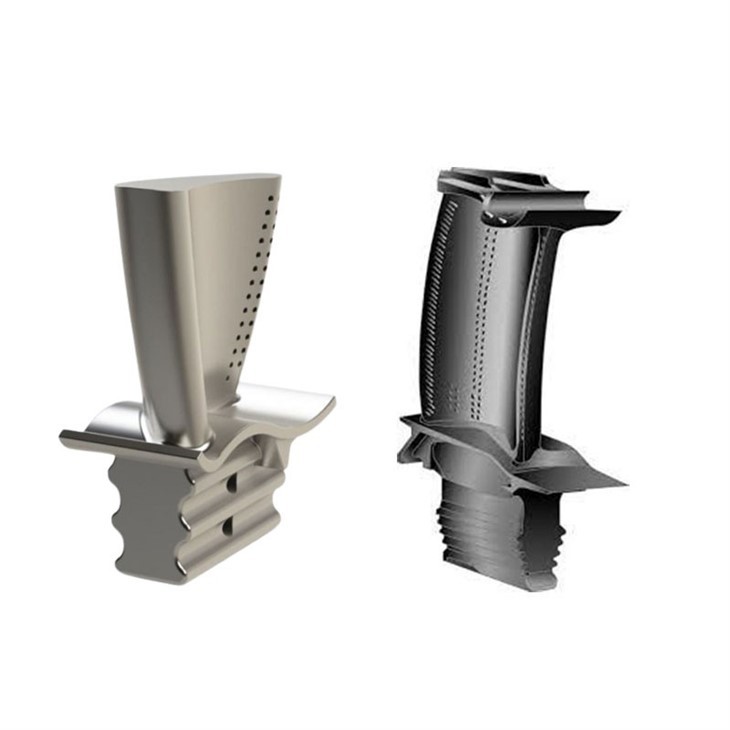


Single Crystal Turbine Blade

Directional crystallization blades eliminate transverse grain boundaries, which are sensitive to voids and cracks, so that all grain boundaries are parallel to the direction of the stress axis, thus improving the alloy's serviceability. Single crystal blade eliminates all the grain boundaries, do not have to add grain boundary strengthening elements, so that the initial melting temperature of the alloy is relatively high, thereby increasing the high-temperature strength of the alloy, and further improve the overall performance of the alloy. Single crystal blades the entire casting consists of a grain composition of the casting of high temperature alloys. This is following the directional solidification casting high temperature alloys, to further improve the strength of the alloy and the use of temperature of a way.
Single crystal blade castings of the ideal organization is the leaf root, leaf body and leaf crown, are composed of defect-free multi-phase single crystal. Crystal orientation should be 〈001〉 direction, and with the blade main stress axis direction between the deviation should not be greater than 10 degrees. Single crystal castings can be prepared with the same equipment and process of directional solidification, and directional solidification castings differ only in the water-cooled chassis of the upper part of the addition of the crystal selector or small crystal, in order to control the single crystal into the casting.


Brief history of the initial single crystal casting high-temperature alloys using ordinary casting high-temperature alloy composition, in this case, single crystal casting high-temperature alloys and directional solidification casting high-temperature alloys, in addition to the improvement of transverse strength and plasticity, and other properties and no significant improvement. the end of the 1970s, the emergence of the removal of the grain boundaries of the strengthened (see high-temperature alloys strengthened by the grain boundaries of the) elements of the single-crystal casting high-temperature alloys, such as the U.S. PwAl480, NASAIRl00.
carbon, boron, zirconium, hafnium and other grain boundary strengthening elements removed to improve the initial melting temperature of the alloy, thus allowing to improve the solid solution treatment temperature, to obtain a finer, more diffuse Y 'phase (see high temperature alloy materials intermetallic compounds phases), so that the alloy's potential to get a fuller play.After more than 20 years of development, more than 20 types of single-crystal cast high-temperature alloys have appeared. These alloys can be divided into three generations: the first generation to PwAl480 as a representative of its temperature-bearing capacity than the best directional solidification casting high-temperature alloy PwAl422 has a 25 ℃ advantage; the second generation to PwAl484 as a representative of the first generation than the first generation and improved by 25 ℃; is being developed is the third generation of single-crystal alloys.

Advantages of Monocrystalline Blades
Higher high-temperature strength
Monocrystalline blades can be used at temperatures up to 1500 ℃, much higher than the polycrystalline blade of 1300 ℃, which is mainly due to its single-crystal metal growth technology and highly uniform crystal structure.
Better corrosion resistance
Due to its excellent oxidation and corrosion resistance, single crystal blades are able to work for long periods of time in extreme environments, such as high temperatures, high pressures, and high speeds.
Reduced heat loss
Due to the homogeneity of their crystal structure, single crystal blades are better adapted to these environments under the same engine operating conditions, resulting in reduced heat loss.
Improved engine performance. Monocrystalline blades have higher aerodynamic and thermal efficiencies, which can improve overall engine performance, such as reducing weight, increasing efficiency, and reducing fuel consumption.
Improved service life and reliability.
Due to their higher resistance to high temperatures, pressures, and speeds, monocrystalline blades have a longer life and higher reliability.

These alloys can be divided into five generations: the first generation of nickel-based single-crystal high-temperature alloys PWA1480, CMSX-2, René N4 and China's production of DD3 as a representative of the ability to bear the temperature than the best directional solidification casting high-temperature alloy PWA1422 has an advantage of 25 ℃; the second generation of PWA1484, CMSX-4, René N5 and DD6 as a representative of the first generation than another Improved about 30 ℃; the third generation of single-crystal alloys René N6, CMRX-10 and DD9, etc., than the first generation of temperature resistance increased by 60 ℃; is currently under development is the fourth and fifth generation of single-crystal high-temperature alloys represented by MC-NG, TMS-138, TMS-162, etc..

Hot Tags: Single Crystal Turbine Blade, China Single Crystal Turbine Blade manufacturers, suppliers, factory, Nickel Alloy Gas Impeller, Inconel 738 LC Gas Turbine, Micro Steam Turbine, Nickel Alloy Gas Turbine, Inconel 718 Turbine, Nickel Alloy Steam Turbine
You Might Also Like


Send Inquiry