


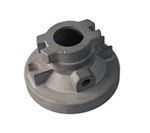


Precision Cast Turbine Blades
In a gas turbine engine, a single turbine stage consists of a rotating disk housing a number of turbine blades and a nozzle guide vane retaining ring in front of the blades. The turbine is connected to the compressor using a shaft (the complete rotating assembly is sometimes called a "spool"). As the air passes through the compressor, it is compressed, increasing its pressure and temperature. The temperature is then raised by fuel combustion in a combustor located between the compressor and turbine. The high temperature and high pressure gas then passes through the turbine. The turbine stage extracts energy from this gas flow, reduces the pressure and temperature of the gas, and transfers the kinetic energy to the compressor. For example, a turbine works in a similar way to a compressor, only in reverse, in terms of the exchange of energy between gas and machine. There is a direct relationship between the amount of change in gas temperature (increase for compressor, decrease for turbine) and shaft power input (compressor) or output (turbine). [8]
For a turbofan engine, the number of turbine stages required to drive the fan increases with increasing bypass ratio [9], unless the turbine speed can be increased by adding a gearbox between the turbine and fan, in which case it is required There are fewer levels. [10] The number of turbine stages has a strong influence on how the turbine blades for each stage are designed. Many gas turbine engines are twin-spool designs, meaning there is a high-pressure rotor and a low-pressure rotor. Other gas turbines use three rotors, with a medium-pressure rotor added between the high-pressure and low-pressure rotors. The high-pressure turbine is exposed to the hottest, highest-pressure air, while the low-pressure turbine is exposed to cooler, lower-pressure air. The difference in conditions results in the design of high-pressure and low-pressure turbine blades that differ significantly in materials and cooling choices, despite the same aerodynamic and thermodynamic principles. [11] Under these harsh operating conditions inside gas and steam turbines, the blades face high temperatures, high stresses, and potentially high vibrations. Turbine blades are a key component of power plants, converting the linear motion of high-temperature and high-pressure steam flowing along the pressure gradient into the rotational motion of the turbine shaft.
Hot Tags: precision cast turbine blades, China precision cast turbine blades manufacturers, suppliers, factory, Aircraft Turbine Blades, Titanium Products, Titanium Alloy Turbine, Titanium Alloy Outdoor, GH2132 Strip, High Pressure Turbine Blade
You Might Also Like




Send Inquiry