


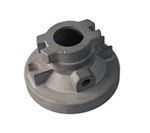


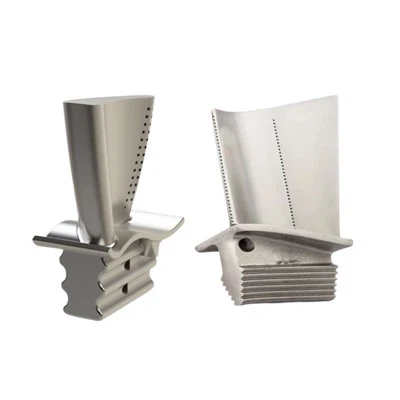
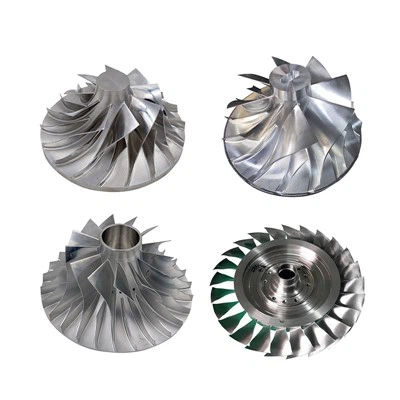
Turbine Blade Impeller
Aviation Technology's main business directions include aviation products and gas turbine power generation equipment. Its main business includes the production, development, and sales of aviation engines and their components, gas turbine components and spare parts, aviation bearings, etc.
Consistent grain orientation
Single crystal blades have grains oriented parallel to the blade axis, which means the overall structure of the blade is more uniform and there are no grain boundaries to weaken its performance.
Excellent High Temperature Performance
Monocrystalline blades can withstand extremely high temperatures without failure, making them ideal for applications such as aero-engines that require high operating temperatures.
Resistance to oxidation and corrosion
Because monocrystalline blades do not contain grain boundaries, they have a smoother surface that is less susceptible to oxidation and corrosion.
Lower susceptibility to fatigue cracking
Monocrystalline blades have a longer service life due to the lower rate of fatigue crack propagation because of the absence of grain boundaries.
Higher Mechanical Properties
The uniform grain structure of monocrystalline blades provides higher tensile and flexural strength, enabling them to withstand higher mechanical loads.
indispensable key component
monocrystalline blades have become an indispensable key component in modern aero-engines and industrial gas turbines, among others, due to their excellent performance in harsh environments such as high temperatures, high pressures, high mechanical loads and corrosion.
Introduce
1. Structure of turbine blades
Turbine blades are usually designed to rotate and directly output power. The impeller blades are usually designed to be stationary and used to expand or decelerate the fluid. For example, in a water pump, the turbine blades are often called propeller blades, and the impeller blades are called skip blades.
2. Working principle of turbine blades
As the fluid passes through the turbine blades, its kinetic energy causes the turbine blades to rotate. Because the turbine blades have different shapes and directions, they experience different fluid forces, which causes the turbine blades to generate a torque. This torque is transmitted to the mechanical device through the shaft to achieve power output.


1. Different operation methods
Turbine blades are usually designed to rotate and directly output power. The impeller blades are usually designed to be stationary and used to expand or decelerate the fluid. For example, in a water pump, the turbine blades are often called propeller blades, and the impeller blades are called skip blades.
2. Different blade thicknesses
Turbine blades, which are power output components, are usually thinner because thinner blades provide a larger blade area, resulting in stronger power output. Impeller blades are usually thicker because thicker blades provide better resistance and expansion.
Hot Tags: turbine blade impeller, China turbine blade impeller manufacturers, suppliers, factory, 4J36 Strip, Hastelloy B 3 Strip, Titanium Alloy Turbine, Titanium Alloy Automotive Fasteners, Inconel 718 Turbine Blade, 5 Axis Turbine Wheel
Previous
Turbine Wheel ShaftYou Might Also Like




Send Inquiry